

Story Lens
Steel, Space, and Seconds
Combat rewards position and timing, not just big numbers
At the bridge choke point, Tamsin did not win by hitting hardest. She stepped inside the spear line, forced the raider backward into uneven stones, and bought her ally one clean opening. The fight turned because of placement, not damage alone.
Combat rules in OpenRPG model that tempo. Initiative, reach, line of sight, and pressure all matter from round to round. You can still be heroic, but heroics land best when the table can see the tactical trade you made to earn them.
- Resolve intent, then position, then roll — so fiction and mechanics stay synchronized.
- Treat advantages like cover, spacing, and setup as real resources that shape outcomes.
- Escalate danger when players overextend, and reward disciplined teamwork with cleaner turns.
Introduction
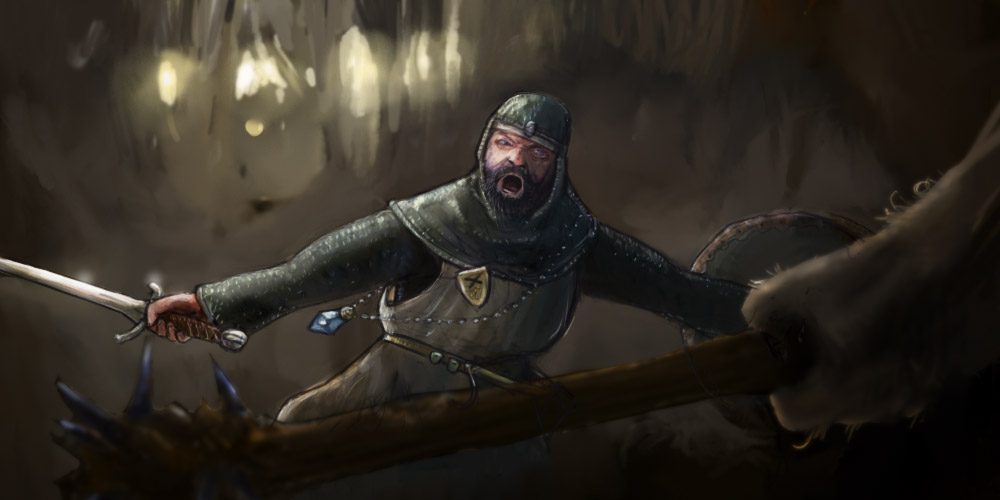
Fights in OpenRPG resolve in seconds of in-world time, but at the table they play out with full tactical depth.
Combat in OpenRPG is unforgiving. Most fights last seconds — a skirmish ends in one or two exchanges, a larger battle in minutes. At the table, the same combat takes longer: each combatant acts in turn, positioning and consequences compound round by round, and a fight involving many factions can fill a session. That pacing is intentional. The tactical detail is what makes the danger feel real.
Dice Mechanics
Combat checks use the same difficulty ladder as the rest of the game — pick the skill, pick the tier, and the sheet provides the target number.
When a combat check matters, choose the relevant skill, then the difficulty tier. The character sheet already shows the target number for that skill at each tier, so you do not build the number yourself. Roll percentile dice and compare the result to that target.
- Attack: choose the relevant combat skill, pick the difficulty tier, and roll against the sheet's target number.
- Defend: choose the defending skill and resolve the same way — the sheet provides the target number.
- Skill use in combat: checks like climbing, shouting commands, or forcing a door during a fight work the same way — each resolves against that skill's target number at the chosen tier.
Difficulty - Combat
Difficulty tier reflects the situation, not the opponent's level. The tier picks the column; the character sheet provides the number.
Difficulty tier reflects the situation — terrain, position, light, footing — not the opponent's level. A level-5 wolf in an open field is still Moderate. Level makes a creature dangerous through its attributes: higher reflexes mean a harder evasion number, higher coordination means a more accurate strike. The tier tells you which column to read; the attributes determine what you are rolling against.
Quick GM Rubric
| Difficulty | Description | Example |
|---|---|---|
| Routine | Automatic or nearly automatic under normal conditions. | Striking a helpless, restrained, or unconscious target. A finishing blow on a downed enemy who cannot resist. |
| Simple | Straightforward for anyone reasonably prepared. | Attacking a prone opponent who cannot actively defend. Striking an unarmored target at close range with a weapon you are trained in. |
| Easy | Favorable, but still requires attention. | Attacking from elevated ground or downhill. Flanking an opponent already engaged with an ally. Hitting a cornered or off-balance target. |
| Moderate | The default meaningful challenge under pressure. | A 1-on-1 sword fight between two trained opponents of similar skill on open ground. The baseline for most combat exchanges. |
| Hard | Risky, pressured, or strongly opposed. | Attacking uphill or into a shield wall. Fighting a faster or more skilled opponent. Defending against two opponents simultaneously. |
| Very Hard | Severe opposition or extremely poor conditions. | Fighting bloodied and exhausted against a fresh opponent. Striking a fully armored target with an inappropriate weapon. Attacking in near-darkness. |
| Improbable | At or beyond normal limits; success requires exceptional luck or mastery. | An untrained farmer striking a knight in full plate in an open field. Threading an arrow through a murder hole at maximum range. Disarming a master swordsman barehanded. |
Movement
Movement is measured in hexes — one hex equals one metre. A combat round is approximately six seconds. Characters may move before and after their main action.
Each combatant has a base movement value derived from their Reflexes, Endurance, and Wits. This value is the number of hexes they can move in a single combat round. Movement may be split freely before and after the main action on a combatant's turn.
- Base movement is measured in hexes. One hex equals one metre.
- A combat round is approximately six seconds.
- Movement may be split — a combatant may move, take their main action, then move again with any remaining movement.
- Sprint speed is base movement ×2 and costs the main action.
- Fleeing costs the full round with no main action, allowing greater distance than a sprint.
- Difficult terrain increases movement cost. Ground obstacles, strong wind, and water flow each apply penalties.
Consequences
Consequences are threshold-based effects triggered by hit outcomes, ranging from short-term penalties to lasting injuries.
When an attack lands, the GM assesses whether the outcome crosses a consequence threshold. Consequences may be physical or mental, short-term or long-term, and can modify skills or attributes.
arrow_forwardConsequences RulesHow consequences work, short-term and long-term effects, named statuses, and recovery.arrow_forwardThe Red LedgerCritical hit and fumble tables by weapon type, location, and damage category.Surprise
A character caught off guard when combat begins loses their first-round action and cannot act until the second round.
Surprise is assessed when one side initiates combat without warning — an ambush, a sudden draw, or an attack from outside a character's awareness. The GM determines whether surprise applies based on the situation. Characters with passive detection skills such as Sense Ambush or Trap Detection may receive a check to avoid being caught off guard; a failed check or no applicable skill means the character is surprised. A surprised character loses their first-round action entirely and joins normal initiative order from round two onward.
- A surprised character loses their entire first-round action — they cannot attack, defend, or move until round two.
- The GM may apply surprise to one side, individual characters, or no one, depending on the scene.
- Passive detection skills (Sense Ambush, Trap Detection) give a character a chance to avoid surprise; the GM sets the difficulty tier from the fiction.
- A character who is surprised but not incapacitated still benefits from any passive armor or damage reduction.
Initiative and Turn Order
Initiative is a sheet-calculated interoperable skill. Combatants act in descending order each round; the GM tracks the sequence.
Each combatant's initiative is an interoperable skill value calculated on the character sheet — no roll required. Before combat begins, the GM records the order from highest to lowest. That sequence holds for the duration of the fight. When every active combatant has taken their turn, the round ends and the cycle repeats from the top.
- Ties are broken by Reflexes first, then Wits. If still tied, the GM determines the order.
- A combatant who joins mid-combat enters the order at their initiative value and acts when their position next comes around.
- Incapacitated or fled combatants are removed from the order.
Turn-Based Combat
Combat is resolved in rounds, usually representing 1 to 6 seconds of real time, with a repeatable sequence for each exchange.
- Assess Surprise: characters caught off guard may lose the first round.
- Determine Initiative: highest initiative acts first, with Reflexes and Wits breaking ties.
- Calculate Fatigue: combat actions reduce stamina, and severe exhaustion imposes escalating action penalties.
- Apply Active Consequences: both short-term and long-term penalties may modify the turn.
- Resolve Attacker Action: choose attack type, determine skill, apply modifiers, and roll percentile dice.
- Resolve Defender Action: choose defense type, determine skill, apply modifiers, and roll percentile dice.
- Resolve Hit and Damage: determine location, severity, weapon damage, and possible armor sundering.
- Apply Consequences: if thresholds are crossed, assign short-term or long-term effects.
- Record Fatigue: both attacker and defender track expenditure after the exchange.
- End of Round: once everyone has acted, return to Step 1 and repeat until combat ends.
Attack and Defense Resolution
Attacks and defenses follow parallel structures: choose the method, determine skill, apply modifiers, then resolve on percentile dice. Both sides roll against their own skill-derived target.
Attacker Action
- Choose attack type or weapon: ranged, thrown, one-handed, two-handed, polearms, shield, unarmed, or other.
- Determine the relevant combat skill from the combat skills reference.
- Apply modifiers, including difficulty, weapon effects, and active consequences.
- Roll percentile dice: 96–100 is a critical success, 01–05 is a critical failure. Ordinary success still requires beating the current target number.
Defender Action
If the attack roll succeeds, the defender selects a defense from the options available to them and rolls against their own skill-derived target number at the current difficulty tier.
| Defense | What it does | Key attributes |
|---|---|---|
| Block | Absorb the blow through mass, body, or a shield. Success negates the hit. | Endurance, Strength, Balance |
| Parry | Redirect the incoming weapon using a held weapon. Success negates the hit. | Strength, Endurance, Reflexes |
| Dodge | Remove yourself from the attack path before impact. Success negates the hit. | Reflexes, Coordination, Balance |
| Riposte | Redirect the attack and immediately counter. Success negates the hit and deals an automatic hit to the attacker — no counter-defense roll. | Coordination, Reflexes, Wits |
Not every defender has every option
Characters can use any defense their skills and equipped weapons support. Creatures and NPCs are limited to the defense skills their archetype defines — a brute may have block but no dodge; a skirmisher can parry, dodge, and riposte but cannot block. Available options are visible on each stat entry.
Hit, Consequences, and End of Round
Once an attack lands, the exchange shifts to location, damage, consequence thresholds, fatigue accounting, and round continuation.
- If an attack lands, roll for location, assess severity, roll weapon damage, and check for armor sundering.
- On a critical success or fumble by either side, consult the Red Ledger for location, severity, and additional effects.
- If consequence thresholds are crossed, the GM decides whether the effect is short-term or long-term and assigns the relevant penalty or bonus.
- Record fatigue changes for both attacker and defender after the exchange.
- At the end of the round, repeat the process from Step 1 until the fight ends.
Combat Difficulty Rubric
| Difficulty | Example | Description |
|---|---|---|
| Routine | Drawing a readied weapon or stepping into clear cover | Automatic or nearly automatic under normal combat conditions. |
| Simple | Calling a warning to an ally or shifting around a fallen body | Straightforward if the fighter has room and no serious interference. |
| Easy | Crossing a short threatened gap or spotting an exposed flank | Favorable, but still shaped by timing and battlefield pressure. |
| Moderate | Shoving past resistance or reloading while under active pressure | The default meaningful combat challenge when opponents are contesting space. |
| Hard | Disarming an alert opponent or forcing a path through a tight melee | Risky, pressured, or strongly opposed. |
| Very Hard | Climbing to a firing position mid-fight or rescuing someone under direct attack | Severe opposition or extremely poor conditions. |
| Improbable | Turning a collapsing position into an escape with a single desperate maneuver | At or beyond normal limits; success requires exceptional luck or mastery. |