

Story Lens
The Right Tool Ends It Faster
What you carry into a fight shapes what kind of fight it becomes
Corren brought a halberd to the ambush in the narrow alley and spent the first exchange trying to find room to swing. His companion drew a knife and ended it. The halberd wasn't wrong — the situation was. Every weapon is correct somewhere and wrong somewhere else.
Weapon rules in OpenRPG give each weapon type mechanical identity: reach, damage type, critical behavior, and weight. Choosing a weapon is a statement about how you intend to fight — and the rules hold you to it.
- Weapon type determines which critical and fumble table applies — the same roll means different things with a slashing weapon versus a piercing one.
- Reach and size interact with spacing and positioning — not every weapon works in every environment.
- Attack modes within a weapon type let trained fighters adapt; untrained fighters use what the weapon offers by default.
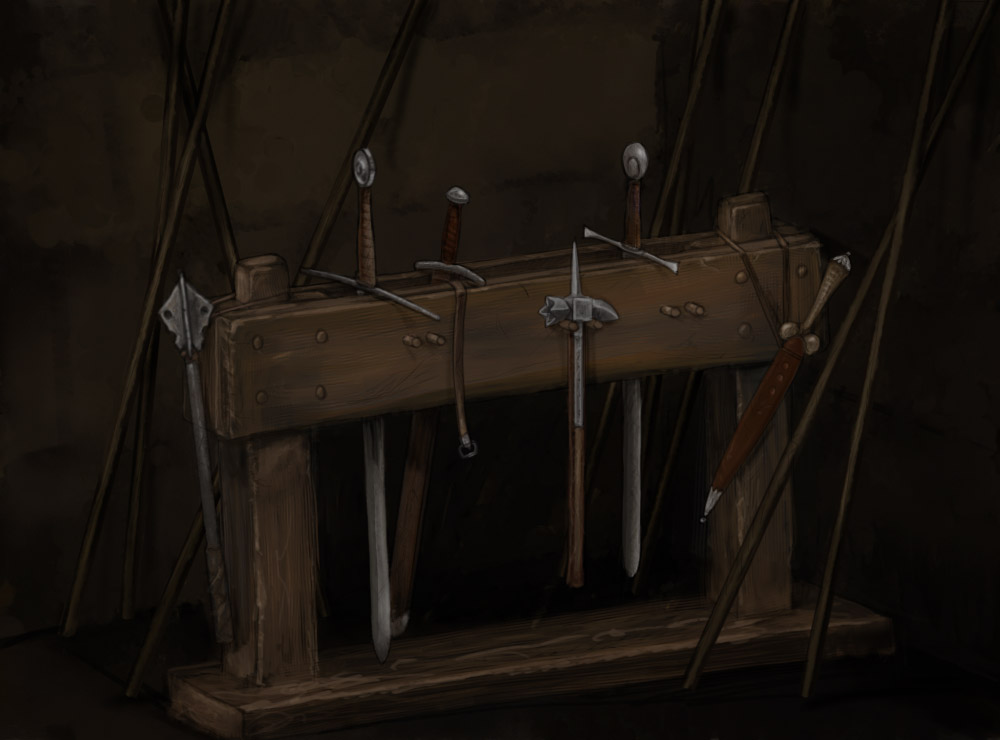
Introduction
Weapons are defined by form, damage type, reach, fatigue cost, and the tactical role they play in a fight.
Weapons in OpenRPG are categorized by form and function: cleaving axes, thrusting spears, slashing swords, and crushing hammers. Each weapon has its own reach, fatigue cost, parry and riposte profile, and scaling damage across creature sizes.
Some weapons are agile and precision-based, while others depend on strength, commitment, and two-handed leverage. Properties such as finesse, versatile, and reach help distinguish their tactical identities.
How Weapons Work
A weapon determines tactical options, damage, reach pressure, and zone of control on the hex map.
The weapon in your hand determines your tactical options, the damage you inflict, and your ability to defend yourself. Each weapon has an Attack Type that defines how you strike — slash, thrust, bash, or cleave — and a Damage Type that determines how armor responds to the blow.
Damage type interacts directly with armor. Plate excels against slashing but struggles against bludgeoning. Padding absorbs cuts but fails against concentrated thrusts. Choosing a weapon means choosing how you want to threaten the armor in front of you.
Reach determines both your attack range and your zone of control on the hex map. Longer reach lets you threaten more hexes and strike first in an approach — but closes distance becomes a liability for Extended weapons when an opponent steps inside their effective range.
The Basics
Attack type, armor interaction, hand usage, reach, and fatigue define the core logic of weapon choice.
- Attack type determines technique: a mace can bash or cleave, a rapier thrusts, and some weapons like longswords support multiple attack types.
- Damage type interacts with armor: armor resists some damage types better than others. Plate struggles against bludgeoning; padding fails against concentrated thrusts.
- Reach falls into four named bands — Close, Standard, Long, and Extended — each with different zone-of-control implications on the hex map.
- Hand usage shapes options: one-handed weapons leave the off-hand free for a shield or second weapon; two-handed weapons trade that flexibility for leverage and damage.
- Fatigue from weapons comes from proficiency, not the weapon itself. Non-proficient use adds +1 fatigue per attack action. The weapon does not have its own fatigue rating.
- Proficiency in a weapon category unlocks its full tactical options — parry, riposte, and special attack types.
Attack Types
Attack types describe the physical technique used by the weapon, and that technique shapes both tactics and outcomes.
| Attack Type | Description |
|---|---|
| SLASH | Wide, sweeping arc that carves through flesh and cleaves limbs. |
| THRUST | Focused point attack driving deep into vital organs and gaps in armor. |
| CLEAVE | Devastating overhead or angled strike with maximum force and weight. |
| BASH | Blunt trauma impact that crushes bone, dents armor, and stuns foes. |
| HOOK | Catching or pulling technique using curved blades, bill hooks, or flails that snag limbs, drag shields, and disrupt footing. |
| GRAPPLE | Body-to-body control technique that seizes, restrains, and pins — removing the opponent's ability to fight freely. |
Weapon Properties
Properties determine how a weapon behaves beyond raw damage, especially in defense, range control, and stamina cost.
| Property | Effect |
|---|---|
| REACH | Distance in meters you can attack from. Longer reach strikes first; shorter weapons excel in tight quarters. |
| HANDS REQUIRED | One-handed leaves options open for shields, grappling, or dual-wielding. Two-handed usually hits harder. |
| BONUS | Accuracy modifier that can make hits easier but may raise fatigue or demand more skill. |
| PARRY BONUS | Defensive modifier when using the weapon to deflect attacks. |
| RIPOSTE BONUS | Counter-attack modifier when punishing an enemy’s failed strike. |
| FATIGUE RATE | How quickly the weapon drains stamina in active combat. |
Reach and Zone of Control
Weapon reach falls into four named bands. Each band determines attack range and zone of control on the hex map.
All weapons are classified into one of four reach bands. The band determines how far the weapon can legally strike and — on the hex map — how many hexes it threatens with zone of control. Reach is not just about striking; it is about controlling space.
| Band | Distance | Hex threat | ZoC | Tactical note |
|---|---|---|---|---|
| Close | ≤ 0.8m | Adjacent only | Adjacent hexes | Daggers, punching weapons. Effective inside an opponent's guard. |
| Standard | 0.9–1.2m | Adjacent only | Adjacent hexes | Most swords, axes, maces. The default combat range. |
| Long | 1.5–2.0m | Adjacent + 1 hex out | Adjacent + 1 hex out | Spears, halberds, long swords. Strikes first on approach; takes a difficulty penalty when enemy closes to adjacent. |
| Extended | 2.5–3.0m | Up to 2 hexes out | Up to 2 hexes out | Pikes, lances, long polearms. Dominant at range; significantly penalised at close distance. |
Inside-distance penalty
Long and Extended weapons suffer a difficulty penalty when an opponent closes inside their effective range. This represents the loss of leverage and the inability to bring the full weapon to bear at close quarters.
| Weapon band | Penalty trigger | Penalty |
|---|---|---|
| Long | Enemy is adjacent (within Close or Standard range) | One difficulty tier bump on attack rolls |
| Extended | Enemy is adjacent | One difficulty tier bump on attack rolls |
- Zone of control is determined by the weapon's reach band, not a flat adjacent-only rule.
- A threatening combatant with a Long weapon exhausts an enemy's remaining movement when the enemy voluntarily enters any hex within ZoC range — adjacent or one hex out.
- Forced movement does not trigger ZoC exhaustion regardless of reach.
- The inside-distance penalty applies on the attacker's turn — not automatically to all rolls while adjacent.
Damage Tiers and Size Scaling
Weapon damage scales with two factors: the weapon's damage tier and the wielder's size. Medium humans are the baseline.
Every weapon belongs to a damage tier based on its form and how it is wielded. The tier sets the base damage die for a Medium-sized wielder. Size then scales the die up or down from that baseline.
| Tier | Die (Medium) | Avg | Examples |
|---|---|---|---|
| Light 1H | 1d6 | 3.5 | Dagger, knife, hand axe |
| Standard 1H | 1d8 | 4.5 | Sword, axe, mace, spear (1H) |
| Versatile | 1d10 | 5.5 | Bastard sword, war axe (1H or 2H) |
| Standard 2H | 2d6 | 7 | Greatsword, spear (2H), halberd |
| Heavy 2H | 2d8 | 9 | Warhammer, maul, great axe, dane axe |
Size scaling
The same weapon deals more or less damage depending on the size of the creature wielding it. Find the weapon's tier in the left column, then read across to the wielder's size.
| Tier | Small | Medium | Large | Huge | Giant |
|---|---|---|---|---|---|
| Light 1H | 1d4 | 1d6 | 1d8 | 1d10 | 2d6 |
| Standard 1H | 1d6 | 1d8 | 1d10 | 2d6 | 2d8 |
| Versatile | 1d8 | 1d10 | 1d12 | 2d8 | 3d6 |
| Standard 2H | 1d10 | 2d6 | 2d8 | 3d6 | 4d6 |
| Heavy 2H | 2d6 | 2d8 | 3d6 | 4d6 | 6d6 |
- Small: halflings, gnomes, children.
- Medium: humans, elves, dwarves — the baseline.
- Large: ogres, large trolls, oversized humanoids.
- Huge: giants, large monsters.
- Giant: the largest creatures in play.
Weapon Tags & Special Properties
Tags describe how a weapon changes tactics, build priorities, and combat rhythm.
- Finesse: relies on precision and speed rather than raw strength.
- Light: low fatigue, excellent for dual-wielding or prolonged exchanges.
- Two-Handed: requires both hands and usually improves damage or reach.
- Versatile: can be used one-handed or two-handed depending on tactical need.
- Reach: extended reach allows earlier strikes but can be unwieldy in tight spaces.
- Parry-Capable: grants defensive value when deflecting attacks.
- Riposte-Capable: rewards enemy mistakes with immediate counters.
- Armor-Piercing: ignores part of damage reduction and is designed to defeat armor.
Combat Integration & Tactics
Weapon choice should respond to armor type, formation, space, and fatigue. Attack type modifiers make the right weapon meaningfully more effective.
Damage type modifiers are applied to the raw damage roll before DR is subtracted. A positive modifier means the weapon exploits a weakness in the armor's construction. A negative modifier means the armor is specifically designed to resist that type of blow.
| Attack type | vs Cloth / Padding | vs Leather | vs Mail | vs Plate |
|---|---|---|---|---|
| SLASH | +2 | +1 | −2 | −3 |
| THRUST | −1 | +1 | +2 | 0 |
| BASH | 0 | 0 | +2 | +3 |
| CLEAVE | +1 | +1 | −1 | −1 |
What this means in play
| Scenario | Base damage | Modifier | DR | Avg dealt |
|---|---|---|---|---|
| Longsword SLASH vs conscript (padding) | 1d8 (4.5) | +2 | 3 | 3.5 |
| Longsword THRUST vs mercenary (mail) | 1d8 (4.5) | +2 | 8 | 0 (max 4) |
| Warhammer BASH vs mercenary (mail) | 2d8 (9) | +2 | 8 | 3 |
| Warhammer BASH vs knight (plate) | 2d8 (9) | +3 | 15 | 0 (max 4) |
| Longsword SLASH vs knight (plate) | 1d8 (4.5) | −3 | 15 | 0 (impossible) |
- Apply the modifier to the damage roll, then subtract total DR at the hit location. Minimum damage is 0.
- A weapon with multiple attack types can choose which to use each strike — a longsword can slash or thrust depending on the situation.
- DR used here is the total stacked DR at the specific body location hit, not a global value.
- The damage-interaction table in the armor rules describes these interactions qualitatively — this table is the mechanical implementation.
Practical Weapon Choices
Example loadouts show how role, reach band, damage type, and proficiency combine into meaningful weapon selection.
Militia Fighter — "The Conscript"
Cheap, effective in formation, and easy to train. Reach is the primary advantage — a spear keeps enemies at distance while the shield covers the gap.
| Weapon | Attack type | Reach band | Damage (M) | Why |
|---|---|---|---|---|
| Spear | Thrust | Long | 1d6 | Long reach, cheap, effective in formation. ZoC extends one hex out. |
| Short sword | Slash / Thrust | Standard | 1d4 | Sidearm when the spear is too slow at close range. Light proficiency. |
Mercenary Veteran — "The Professional"
Versatile loadout built around a weapon with multiple attack types and strong defensive options. Proficiency unlocks parry and riposte.
| Weapon | Attack type | Reach band | Damage (M) | Parry | Riposte | Why |
|---|---|---|---|---|---|---|
| Longsword | Slash / Thrust | Standard | 1d6 | +2 | +1 | Versatile, excellent parrying, supports multiple lines of play. |
| Dagger | Thrust | Close | 1d4 | +1 | +2 | Inside-distance option when grappled or at close quarters. |
Heavy Infantry — "The Breaker"
Built to punch through heavy armor with bludgeoning damage and two-handed leverage. Trades speed and flexibility for maximum damage output against armored targets.
| Weapon | Attack type | Reach band | Damage (M) | Hands | Why |
|---|---|---|---|---|---|
| Warhammer (2H) | Bash / Cleave | Standard | 2d6 | 2 | Bludgeoning damage counters plate. Heavy proficiency. Non-proficient use adds +1 fatigue per attack. |
| Dane Axe | Cleave | Long | 2d6 | 2 | Extended ZoC at Long reach. Cleave threatens adjacent targets in tight formations. |
Fatigue and weapons
Weapons do not have their own fatigue rating. Weapon attacks cost 0 fatigue by default. Non-proficient use adds +1 fatigue per attack action — the cost is from fighting badly, not from the weapon itself. Sprint, charge, and imbuement use are the actions that carry a base fatigue cost.