

Story Lens
Before the First Roll
Who you are before the dice land is already a decision
Ilene's first session, she almost talked her way past the gate guard. Almost — because Persuasion was strong but her profession gave her no context for nobility, and the guard could hear it. The numbers were high enough. The fiction wasn't.
Character creation in OpenRPG is a set of interlocking decisions about origin and tendency, not just resource allocation. Your profession, ethnicity, and religion shape what you can do and what the world assumes about you before you speak. The rules reflect that weight.
- Attributes are spread across 21 values in three families — physical, mental, and sense — because granularity in what you're good at produces distinct characters.
- Profession, ethnicity, and religion each contribute tier bonuses that stack — aligned choices create specialists, spread choices create generalists.
- The character sheet is a prediction about who this person is under pressure. Build it like you mean it.
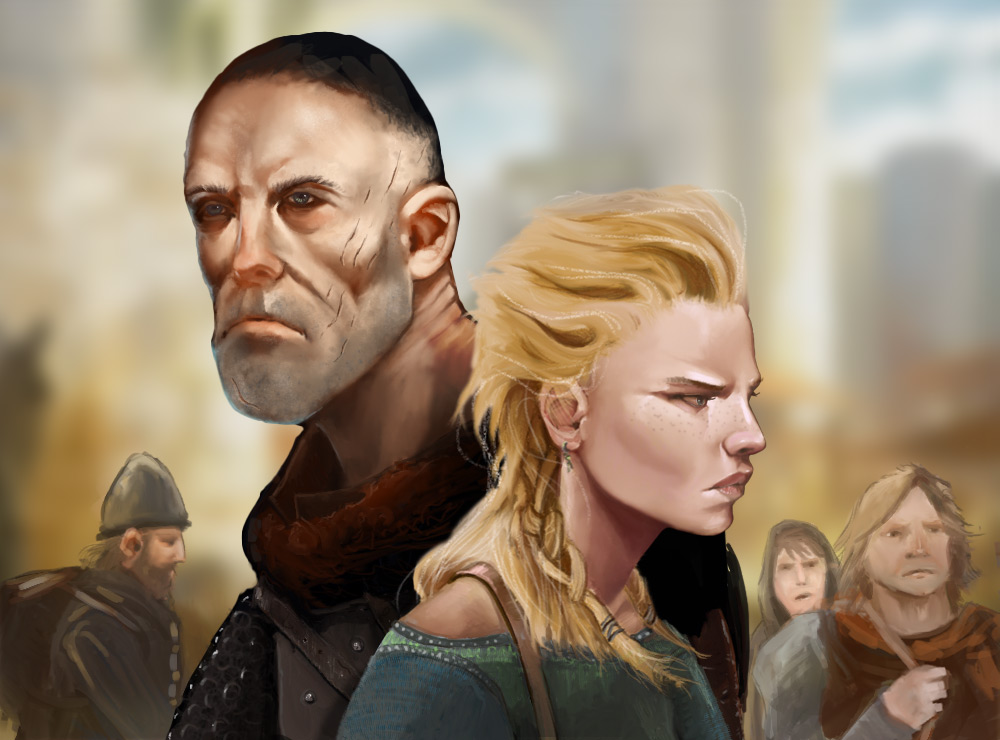
Create an Origin Story
Character creation in OpenRPG moves from identity and world choice into attributes, skills, and final presentation.
The character creation flow guides you through initial details, general background, attribute assignment, skill choices, and final summary. The goal is to turn a rules skeleton into a playable person with both mechanical strengths and narrative direction.
At Level 1, every hero begins with 50 points in each attribute and receives 200 bonus points to distribute. The shape of that allocation determines the first version of the character’s playstyle.
Choose Your Realm
The selected world determines which cultures, faiths, professions, and lore structures apply to the character.
OpenRPG supports multiple realms. When creating a new hero, you first choose which world will witness their deeds. That decision shapes which ethnicities, religions, and profession options are available.
In Openheim, rich cultural and religious layers are part of the character build. In a more generic or future setting, characters may be created with fewer world-specific constraints.
Initial Stats
Initial stats define the character’s identity, body, and presentation before deeper rules layering begins.
Initial stats establish the character’s profile and visual identity. Some fields are descriptive only, while others influence later rule calculations or character generation tools.
| Field | Description |
|---|---|
| Age | May affect attributes in future steps. |
| Eye Color | Affects mugshot generation. |
| Hair Color | Affects mugshot generation. |
| Height | May affect attributes in future steps. |
| Name | The character’s core identifier. |
| Sex | A matter of character identity and preference, with no direct mechanical effect in the current rules. |
| Skin Color | Affects mugshot generation. |
| Weight | May affect attributes in future steps. |
General Stats
General stats connect a character to setting, advancement, and broader identity once a world is selected.
General stats are available when a character is created inside a world such as Openheim. These fields connect the character to society, belief, and advancement progression.
| Field | Description |
|---|---|
| Ethnicity | May affect attributes or skills in future steps. |
| Experience | Starts at zero and increases as the character levels. |
| Languages | Choose one or more languages present in the selected world. |
| Level | Characters begin at Level 1 and improve through experience. |
| Profession | May affect attributes, skills, and build direction. |
| Religion | May affect attributes, skills, and spiritual alignment. |
Profession, Ethnicity, and Religion Bonuses
Background layers shape both the story and the mechanics of a character through a shared three-tier bonus structure.
Profession, Ethnicity, and Religion each grant bonuses that shape how the character performs in play. These bonuses are structured in primary, secondary, and tertiary tiers so that every background choice matters mechanically.
- Primary bonus: the most significant benefit and the clearest expression of that background’s focus.
- Secondary bonus: a supporting or complementary improvement.
- Tertiary bonus: a smaller benefit that rounds out the character.
- Bonuses can apply either to attributes or to skills.
- Profession, Ethnicity, and Religion bonuses stack together and can create strong synergies or broad utility.
When choosing among these options, consider both the narrative identity they create and the mechanical direction they support.
Physical Attributes
Physical attributes define power, movement, resilience, control, and bodily presence.
Physical attributes shape bodily capability, environmental resilience, and many combat-facing mechanics. They form the foundation of movement, carrying capacity, and raw action under pressure.
| Field | Description |
|---|---|
| Strength | Raw physical power and carrying ability. |
| Reflexes | Reaction speed in unpredictable physical situations. |
| Coordination | Precision, dexterity, and hand-eye control. |
| Endurance | Stamina and sustained physical effort. |
| Flexibility | Range of motion and bodily adaptability. |
| Balance | Stability, posture, and control on unstable footing. |
| Appearance | Physical attractiveness and visible presence. |
Mental Attributes
Mental attributes shape cognition, judgment, discipline, and social force.
Mental attributes govern focus, reasoning, memory, instinct, and force of personality. They anchor problem solving, willpower, and many social or strategic choices.
| Field | Description |
|---|---|
| Discipline | Focus, self-control, and persistence. |
| Intuition | Instinctive leaps of understanding. |
| Reasoning | Logic and problem solving. |
| Memory | Retention and recall of information. |
| Wits | Mental agility and improvisation. |
| Wisdom | Judgment informed by experience. |
| Charisma | Presence, persuasion, and influence. |
Sensory Attributes
Sensory attributes separate perception into distinct channels instead of collapsing awareness into one universal stat.
Sensory attributes define perceptual and empathic awareness. Rather than using a single perception score for everything, OpenRPG treats hearing, sight, smell, taste, emotion, touch, and faith as distinct capabilities.
| Field | Description |
|---|---|
| Hearing | Ability to detect and interpret sound. |
| Sight | Visual acuity and detail recognition. |
| Smell | Sensitivity to scent and chemical traces. |
| Taste | Ability to discern flavors and impurities. |
| Emotion | Empathic sensitivity to the feelings of others. |
| Touch | Sensitivity to texture, pressure, and temperature. |
| Faith | Spiritual perception and mystical connection. |
Interoperability Attributes (Calculated)
Derived values translate core attributes into directly playable statistics such as health, movement, fatigue, and initiative.
Interoperability attributes are not assigned directly. They are calculated from combinations of Physical, Mental, and Sensory attributes and act as the bridge between character creation and active play.
| Field | Key Attributes | Description |
|---|---|---|
| Hit Points | Strength, Endurance, Discipline | Overall health and resilience; how much damage a character can take. |
| Base Movement | Reflexes, Endurance | How far a character can travel within a set time frame. |
| Fatigue | Strength, Endurance, Discipline | Stamina under sustained strain; determines how long the character can keep pushing before exhaustion penalties escalate. |
| Encumbrance | Strength, Endurance, Balance | How much weight the character can bear before penalties apply. |
| Attunement | Wisdom, Faith, Reasoning | Capacity to connect with and use magical talismans or artifacts. |
| Initiative | Reflexes, Wits | Reaction speed in combat and other fast-moving situations. |
Why HP comes from attributes
Every point you invest in Endurance and Strength is a direct investment in survivability. There is no separate HP pool, no level-up HP roll, no class-granted buffer above your actual physical investment. A scholar who neglects both attributes is genuinely fragile -- and that fragility is meaningful. The tradeoff is intentional: the system does not inflate survivability with levels, so danger stays real at every tier of play.
Skills
Skills and imbuements are deep enough to warrant their own dedicated references outside the creation summary page.
Detailed skill explanations are covered on the Skill Descriptions page, while deeper imbuement coverage lives on the Imbuement Descriptions page. Character creation uses those systems, but does not need to duplicate all of their rules text here.
Character Summary, Save, and Print
The final stage of creation turns the build into a reusable character record and supports both digital and printable play.
Character Summary is where the player writes background and gives the build a narrative identity. It is also where character presentation tools such as mugshot generation connect back to the chosen details.
Once creation is complete, the character can be saved for future sessions. Players can manage a limited roster of characters and return to them as campaigns continue.
Characters can also be printed to PDF or paper for tables that prefer a physical copy alongside or instead of the online tools.
Example Characters
Explore worked examples demonstrating different build strategies using the 21-attribute system.