

Openheim History
From the Pressing to the Present Age
The cosmological history of the membrane world — from the formation of the universe between two infinities to 600 AF and a realm fracturing quietly.
Cosmological Foundation
The membrane world — squeezed into existence between two infinite universes.
Openheim's world does not exist within a single universe. It exists between two.
The Flame and the Dark are not forces, not metaphors, and not gods. They are entire universes — complete, infinite, and ancient beyond any measure this world possesses. They press against one another across a boundary that is not space as either universe understands it. Neither perceives the other. Neither perceives what their pressure creates between them.
The world is that creation. Not born from within either universe, but wrung into existence by their mutual compression — the bruise at the collision point, the scar tissue of two infinities grinding against each other. It belongs to neither. It is cosmologically orphaned: neutral membrane territory between two incomprehensible wholes.
The stars are the most visible evidence of this. They are not distant suns in the conventional sense. They are points where the Flame universe pressed closest to the membrane and nearly broke through — near-punctures, partially healed. What observers see as starlight is the membrane under stress at those points, glowing where it almost failed. When a star goes dark, a wound has closed. When a new star appears, something from the Flame side has pressed too hard again.
The Dark universe has its own membrane-pressure, but it does not bleed through as light. Its presence is felt in depths, in silences, in shadows that exist without apparent sources — the Dark side seeping through where the membrane thins from the other direction.
Because the world sits between two complete universes, its physical matter has latent structural access to both. This is not magic. It is the physics of a membrane world. The consequence of that access — what one civilization eventually learned to do with it — is what Openheim's scholars call imbuement.
Era I — The Pressing
Before measured time. The membrane world is squeezed into being.
The two universes find one another. Pressure accumulates. Between them, the membrane solidifies.
The world forms not from within either universe but as a consequence of their contact — matter, space, and time developing their own logic in the compressed zone between two cosmological infinities. Stars scar the membrane where the Flame side almost broke through. The geology of the deep world carries the structural imprint of both universes: Flame-resonant in some formations, Dark-resonant in others, and everywhere the latent channels that run to both sides remain open at a level below ordinary matter.
There is no witness to this era. The Church of the Eternal Flame calls it the Primordial Balance. The Hearth-Kin of the Stone Plains call it the First Spark. The Maw-Whisperers call it the First Hunger. All of them are describing the same pressure from different angles, across vast distances of time.
Era II — The Enlightened Age
Millions of years. The Veth evolve from the membrane itself and master imbuement.
From the membrane itself, life emerges.
The Veth did not arrive on the world. They did not evolve on its surface in any sense a later civilization would recognise. They arose from it — expressions of the membrane's own complexity, shaped by the latent access to both universes that permeates the world's deep structure. Their biology, cognition, and perception were calibrated to a reality that sits between two universes. They felt both the Flame and the Dark as environmental fact, the way a human feels warmth or cold.
They were not human but something genuinely Other — their form, their communication, their experience of time and self belonging to categories that have no equivalent in any tongue spoken since. Whether they were singular organisms, collective intelligences, or something with no comparable frame is a question Openheim's scholars have never been positioned to ask, let alone answer.
Over millions of years, the Veth studied the pressure they were born from. They learned that the membrane's latent access to both universes could be made permanent and localised in physical objects. This discovery — reached across spans of time that dwarf all recorded human history — is what Openheim's scholars call the origin of imbuement.
Four structural access points were discovered on the membrane. The Veth mastered each channel type:
- Flame-sourced — drawing from the Flame universe directly
- Dark-sourced — drawing from the Dark universe directly
- Grounded — drawing from the membrane world's own matter and accumulated tension
- Star-sourced — drawing from the near-bleeds, the partially healed puncture points, which carry unique properties of Flame energy under membrane stress
Era III — The Great Work
Hundreds of thousands of years ago. The Giant Stones are placed. The artifact ecology is seeded.
The Veth at their height.
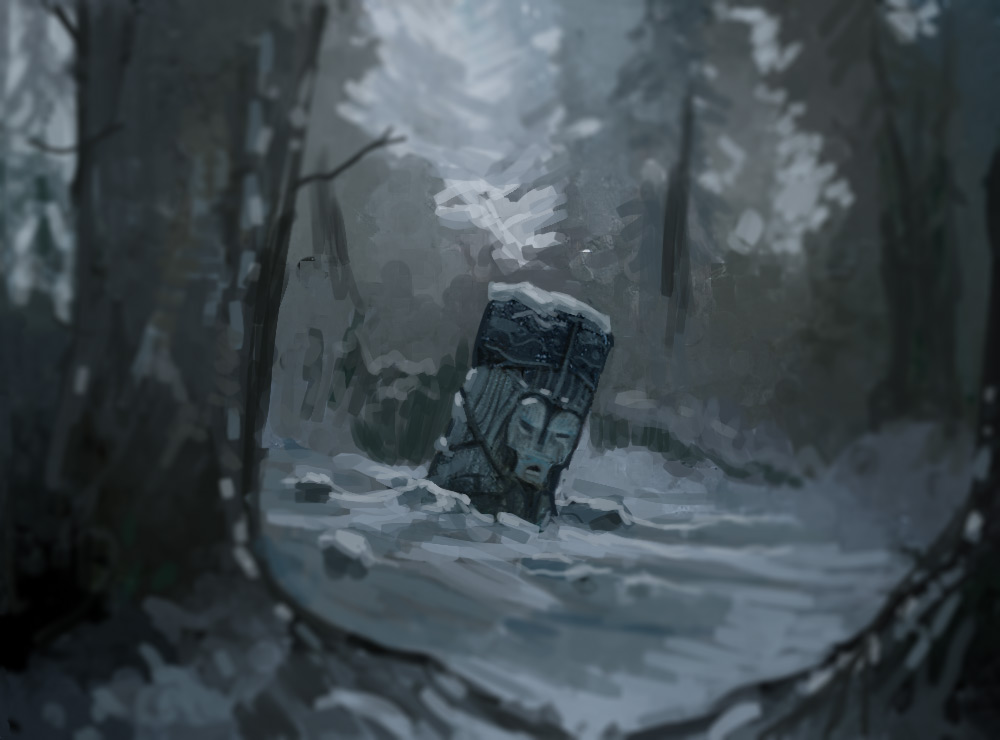
The Giant Stones are placed during this era across the entire planet — seeded into every continent, every coast, every geography the Veth inhabited. They are not monuments. They are not decorations. They are the most sophisticated artifacts the Veth ever created: permanent open channels of such breadth and depth that they can receive and transmit knowledge itself — capable of revealing what the world has observed across geological time to any sufficiently attuned mind that stands before them. They are immovable because they are not resting on the world. They are expressions of it, continuous with its deep structure, placed at specific locations for reasons that no subsequent civilisation has fully understood.
Alongside the stones, thousands of smaller artifacts are created and distributed across the membrane world. Tools and objects of specific purpose. All drawing power continuously from the universe they are bridged to.
The Veth do not appear to have taught. There is no evidence they attempted to communicate their understanding to any other form of life, or that they anticipated any. What they were building toward — what the Great Work was ultimately in service of — is not recorded anywhere that survives or as yet discovered.
Era IV — The Withdrawal
The Veth do not die. They go inward, into the membrane itself.
The Veth vanish from the world. They go somewhere no observer can follow.
Not into the Flame universe. Not into the Dark. Inward — into the membrane itself, into the deep structure of the world they always, in some sense, were. The withdrawal appears to have been deliberate. Nothing in the evidence suggests extinction, catastrophe, or defeat. The artifacts continue to function perfectly. The Giant Stones continue to speak.
What the world inherits from the withdrawal: the artifacts still working, the stones still present, and the Veth themselves still there — dissolved into the membrane's deep structure, present at a scale and depth that ordinary civilisation cannot perceive. The world is not abandoned. It is occupied, very quietly, by something that changed its relationship to surface existence.
Why they withdrew is the question Openheim's scholars, theologians, and heretics have spent centuries misframing. The Church of the Eternal Flame holds that the Veth achieved a perfect balance and no longer required form. Certain Altgrafen traditions, closer to geological truth than they know, say the Veth were called inward by the membrane itself. A small number of heretical scholars — most of whom have not been heard from again — have suggested the Veth withdrew from something, retreating before a threat that neither the Flame nor Dark universe itself represents. No consensus exists. The question is marked, in the few scholarly texts that address it honestly, as unresolved.
Era V — The Hollow Centuries
The world after the Veth, before human civilization.
The world after the withdrawal. Before humanity as it now exists.
The artifacts still function. The Giant Stones still stand. But no one is there to use them, approach them, or understand what they are. The ruins of the Veth — such as they are — slowly acquire the look of landscape rather than architecture. What the Veth built was not separate from the world; it was continuous with it. Their structures do not crumble in the way human buildings crumble. They settle. They become hills, foundations, the shapes beneath forests.
Proto-human populations exist during some portion of this era. Whether they evolved independently, were in some sense cultivated by the Veth, or represent a lesser order of membrane-life that was always present alongside the Veth is genuinely unknown.
The Giant Stones begin accumulating pilgrims even in deep prehistory. Even before language, before theology, before the cognitive apparatus to describe what was being experienced — something in early human consciousness responds to the stones' presence. The revelations become the first organised spiritual experiences this world records, though they are recorded only in the bones of the cultures they shaped, not in any surviving text.
Era VI — The Age of First Tongues
Human peoples differentiate. The nine ethnic traditions of Openheim take shape.
Altgrafen people arrive forcing the Proto-human tribes to the edges of the world. Human peoples begin to differentiate. The ancestors of Openheim's current nations take shape.
Geography drives the divergence. The membrane world has diverse terrain, and populations separated by mountains, forests, coasts, and tundra develop distinct relationships with the artifacts and stones they encounter locally. The stones in different regions give different revelations — or give the same revelations through cultural frames so different that the resulting religions appear to contradict one another while describing the same underlying reality.
The five ethnic traditions that persist into Openheim's present crystallise during this era, each shaped by specific regional expressions:
- Altgrafen — The first men to settle the membrane world, form the core population in the fertile low grasslands of the central steppes.
- Wealden — These men settled the rugged highlands and mountains in the west and northwest, forging a resilient frontier life.
- Fenmen — Settling east, these men live on and around the flat inland sea and it's shallow shores and islands.
- Suddowen — These stoic men settled south in the hilly, jagged coasts overlooking the dark treacherous sea.
- Karnfolk — Occupying the northeast land between the inland sea and untamed wild-lands, these men endure constant threats from Proto-humans and raiders.
Artifacts are encountered throughout this era and interpreted as magical objects — blessed, cursed, old beyond imagining. The physics of channels is entirely lost. The function remains. The wrong explanations accumulate into the foundations of theology.
Era VII — The Age of Kingdoms
The Church of the Eternal Flame achieves dominance. Heresies emerge. Artifacts become political capital.
Civilisations stabilise. Competing interpretations of the cosmological situation reach institutional form.
The Church of the Eternal Flame achieves dominance across the largest portion of the inhabited world. Its core teaching — that the balance between Flame and Dark must be maintained, that neither power should dominate, that the faithful are responsible for keeping the tension productive — is the most politically stable interpretation available. It neither demands the tension be resolved nor denies that it is real. It makes the tension holy. This is brilliant organisational theology, even if it is wrong about what the Flame and Dark actually are.
The heresies emerge as institutional challengers, each representing a genuine logical alternative:
- Extinguish one pole entirely — the Pyre Ascetics, the Smothered Covenant
- Force the poles into synthesis — the Twin-Blade Kindlers
- Allow the poles to reconcile — the Ashen Diplomats
- Privatise the balance rather than share it — the Ember Thieves
The tribal traditions — the Hearth-Kin's sibling memory, the Maw-Whisperers' predator-prey frame — persist at the margins as the oldest surviving cosmological frameworks, running on oral transmission from the Age of First Tongues without institutional backing.
The Giant Stones across the Openheim region become sites of formal pilgrimage. The Church works to interpret and contain the revelations they give, since an oracle that speaks in geological time and cannot be controlled by doctrine is an institutional problem. The Church's control is incomplete. It always has been.
Artifacts become political capital. Control of a powerful artifact confers military and symbolic advantage. Ducal houses that hold significant artifacts accumulate disproportionate power.
Ancient ruins become excavation sites. The first scholarly tradition around the Veth's remains emerges. In academic writing they are the Intercessors: those who stood between cosmic forces, whose legacy persists in the objects they left. In common speech, in the mouths of farmers near ancient stones and children warned away from crumbling foundations, they are simply the Between: the ones who were here before everything else that was here, and still are. The word carved into certain ruins — in a form that predates any alphabet scholars can date — reads Veth. Scholars have not agreed on what it means, whether it is a name or a warning or something with no equivalent category.
Era VIII — The Formation of Openheim
Roughly six centuries before the present. The elective monarchy takes shape.
The political entity that becomes Openheim takes its current shape.
Scholars and court annalists mark this consolidation as Year One of the Openheim calendar. Everything players encounter in the present age — Albrecht's faltering throne, the Church's trans-ducal reach, the ducal rivalries — unfolds within the six centuries that follow.
The Elective Monarchy is established across ten duchies — an arrangement in which the High King is chosen by ducal consensus rather than inherited. The elective mechanism is a compromise reached after the last great empire in the region fractured without catastrophe: no single line could claim cosmological legitimacy, so legitimacy was made collective and periodic. The Church of the Eternal Flame may have brokered the arrangement; it has certainly benefited from it, becoming the one institution that crosses all ducal boundaries while the monarchy remains perpetually constrained.
The duchies imperfectly map to ethnic distribution. Altgrafen populations dominate the interior. Fenmen lineage concentrates on the eastern coast. Wealden clans hold the western highland marches. The other ethnicities weave through the map in patterns that reflect centuries of migration, intermarriage, war, and settlement that no clean ducal boundary can contain.
Ruins throughout the realm are understood as sources of wealth. Artifacts are heirlooms, weapons, and objects of legend. No one — not the Church, not the most decorated scholar, not the most experienced relic-hunter — understands what the artifacts are or where their power originates. The Giant Stones stand in their places. Pilgrims still come. Revelations are still given.
The geography that shaped Openheim carries the memory of the Veth's presence in its structure. The Ironcrag Ranges in the north and northwest, the Duskthorn Mountains in the west, the Maelstrom Sea to the south, the Azure Inland Sea to the east — these are not neutral terrain. They are the surface expression of deep-structure forces that the Veth understood and the current world does not. The gothic quality of Openheim's atmosphere — the mist, the weight of the air, the perpetual sense of something ancient and enormous nearby — is not literary flavour. It is geology.
Era IX — The Present Age
600 AF. Albrecht the Hollow. A realm fracturing quietly.
Openheim counts its years from the founding of the realm, not from any calendar shared with our world. The present year is 600 AF — six hundred years after the elective monarchy and twenty duchies took shape. The culture, technology, and social texture of the realm nevertheless resemble twelfth-century medieval Europe: stone castles, mailed knights, cathedral towns, and feudal courts. That resemblance is an aesthetic and structural reference, not a claim that Openheim shares Earth's historical timeline.
Albrecht the Hollow sits the elective throne. A diminished king. His authority erodes through ducal competition, Church encroachment, and the particular entropy of a man who does not understand the function he was placed to serve. The realm fractures quietly — border raids from the Ironcrag clans, Duskthorn monstrosities in the west, peasant unrest, tax pressure on communities the central authority cannot protect.
The Church of the Eternal Flame dominates spiritual life without having resolved a single cosmological question since its founding. It holds power by controlling the narrative around the Flame-Dark balance, by owning the formal interpretation of Giant Stone revelations, and by maintaining the one trans-ducal institutional network the realm possesses. It cannot explain why artifacts work. It cannot repair them when they break. It maintains authority by maintaining mystery, which is a strategy with a finite lifespan.
Scholars study artifacts with increasing sophistication and persistent wrongness. Their observations are careful. Their categorisations are real. Their explanations are wrong in the specific way that occurs when intelligent people are missing one piece of information they cannot possibly have — working with functions without channels, effects without connections, products without understanding of what produced them.
Ruins throughout the realm contain broken artifacts that still wield imbuement — channels no one can close, connections no one can sever, objects that function according to physics no current civilisation has the vocabulary to describe. Excavation is dangerous. It is also lucrative. Both things are true simultaneously, which is why it continues.
The Giant Stones stand where they have always stood. They cannot be moved. No attempt to move them has succeeded or been survived in any form that allows subsequent reporting. Pilgrims approach them. Revelations are received — true, always, and always requiring interpretation that the receiving mind performs alone. The Church sends representatives to attend and document. The documentation accumulates. The understanding does not.
The Veth have not gone. They withdrew into the membrane of the world millions of years ago, and they are still there — in the deep structure of the geology, in the stones that are their most direct remaining presence, in the artifacts that are still open, still connected, still drawing from universes that have not stopped existing. The world is occupied. It has always been occupied. The current inhabitants build their duchies and their theologies and their scholarly footnotes on the body of something that changed its relationship to surface existence and has been waiting, at geological depth, ever since. What it is waiting for is not recorded anywhere that survives.
Scholar's Note on Naming
The three names by which the ancient civilization is known — and what none of them mean.
The ancient civilization is known by three names in current usage, none of which it gave itself.
The Intercessors — formal scholarly and ecclesiastical usage. Found in academic texts, Church documents, and official records. Implies a mediating role between cosmic forces, which the Church finds theologically useful. Most widely written.
The Between — common folk usage. Very old. Predates the academies. What farmers call them, what children are warned about, what innkeepers mean when they lower their voice and gesture toward the stones outside town. The oldest surviving name in spoken tradition.
Veth — found carved in certain ruins in a form that predates all dateable alphabets. Scholars have not agreed on whether this is a name, a warning, a descriptor, or a category with no equivalent in any language currently spoken. It appears in the oldest strata of the ruins consistently. It appears nowhere else.